Wednesday, November 8, 2023


Bethlehem Baptist in Moldova invites us to share their joy. They celebrated more baptisms of young an old!

It is always a source of rejoicing to hear of baptisms (our home church in America, First Baptist in Columbia, MO, will be having a baptismal service this Sunday--Alleluia!).

We are particularly rejoicing over this baptism because we recognize so many faces. Several young people came to the summer children's day camps we used to help with. The women's patient faces also look familiar.

Welcome, brothers and sisters, into the family!

Perhaps their witness will inspire some of the others who attended to also join the family of God!


Saturday, October 28, 2023


This year's Offering for Global Missions highlights the work of Shane & Dianne McNary. Shane explained to me their approach to work with Roma:

We intentionally chose to come alongside of Roma organizations who were either already engaged in ministry/work or who needed a catalyst to begin their work. We made it clear that we were there to assist as needed and not to manage or assume responsibility.
Slovak contains two main words to describe a project where two or more are working together, cooperating: spolupraca, literally working together; and druzba, friendship. While druzba would sound so perfect to describe what we were aiming for, we learned that the word had historically been used by Russians to describe the 'cooperative' work done between Moscow and Czechoslovakia. Druzba came to mean the antithesis of working together. It was a top-down, dominant-subjugated relationship. Paternalism resulted from druzba. Therefore, when we wanted to test the waters, so to speak, about working together, we would continually speak of spolupraca and then mention druzba as the model we were not interested in. It communicated very, very clearly beyond the meaning of the words to the true intent of the relationship we sought.
Each work began with listening to what they (the local Roma) were doing or wanted to do so we could discern if it was something we could assist with. Sometimes there were things which were excellent, but not a focus of our ministry. In those cases - a bio-farm that employed Roma, a Catholic priest who was working with the community to repair a football (soccer) pitch - we listened and learned and said clearly that this was not something we are engaged in.
Another key, early conversation when we were listening and learning about what the groups were doing was when we began to brainstorm together about how we could collaborate. If we could come up with a project or series of steps where we were comfortable journeying together with them, I would insist that they understand what I meant when I said, "Tomorrow I will die. So whatever we commit to, together, today, you must be willing to carry it on without our presence." If they understood, we would move forward. If it was clear that the project required our presence, then we backed out.
On money (I highly recommend Jonathan Bonk's Missions and Money, revised and expanded edition. Should be required reading for every missionary), other than the one-time-only gifts which we did intentionally and with full awareness of those we sponsored, we were very careful not to rush in with money as a fix for any problem. When we did commit to working together, we were very clear about the use of the funds before we ever transferred any money . . ..
And finally, trust. My trust was not primarily that the Roma would spend money the way I wanted, for what I intended, and in ways that would please me. My trust was always that the money would be spent for what was most needed - both program money with schools, churches, NGO's and with individuals. And because my trust also extended to those I partnered with, I no longer saw money/resources as the primary measure of ministry anyway. Faithfulness to the relationship I had established took precedence over successful implementation of the program/plan/budget I had worked out with them.
Shane and Dianne McNary worked with Roma during the 19 years they served with the Cooperative Baptist Fellowship in Slovakia and Czech Republic. They have now transitioned to working with CBF Great Rivers Fellowship (Shane) and as advocate for the Offering for Global Missions (Dianne).

Friday, September 15, 2023

For many, summer is over and the regular rhythm of work and study has begun again. This includes our friend Zoltan. This week he begins meeting with the Romany children in Porumbeni, Romania. They will pray together, maybe sing a few songs, learn about God's mercy, and play a Davar game or two. 

This week's lesson is about Jeroboam and Rehoboam (remember those guys?). Rehoboam was one of King Solomon's sons. He wasn't as wise as Solomon, and only two of the twelve tribes accepted him as king. The others chose Jeroboam. And Jeroboam chose to trust his own wisdom to solidify his power. He was afraid that if his people continued to trek to Jerusalem to worship Jehovah, they would fall away from him. So he helped them fall away from Jehovah by setting up a couple of golden calves in Israel where they could go to worship. You can read all about it in I Kings 12. 

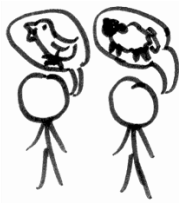
Zoltan plans to play either a version of Simon Says (who are you going to listen to? whose directions are you going to follow?) or Davar Start Game A7, Who do you hear? (Two people make animal noises--a calf, for Jeroboam and a lion or lamb for Rehoboam). 

This children's club is on one end of the Romany settlement. A family on the other end asked to have a children's club meet in their home, too, for the children around that area. Zoltan plans to meet that family this week, so see whether they still want to do this and to make other arrangements.

Prayer for the start of the regular club and the possible addition of a second one will be appreciated.

(Also, if your own club is willing to make a short video of this game, let us know. We're looking to add to the play list of Davar games.)


1429193035A7: Who Do You Hear?

Needed: Nothing extra.

Activity:

  1. Choose two people to make the sounds of two different animals. The sounds should differ only a little bit. For example, in American English, these might be a sheep, “baa”, and a chicken “baak, bak, baak”.
  2. These two people stand in front of the group with their backs to the group. Tell the group which animal sounds to expect. When person “A” makes his animal sound, those listening raise their right hand or do some other distinctive movement. When person “B” makes her animal sound, those listening raise their left hand or make some other sign.
  3. After a while let others take a turn at making other sounds. The fun is in making weird sounds. Make sure you laugh a lot together.
  4. Point out the differences in the sounds, too, or ask for someone to describe the differences in the two sounds.
  5. On the board or big sheet of paper you might write the letter that the different sound represents (the “k” sound in the English example).
  6. Repeat with different people in front making different sounds.

Friday, September 8, 2023

Turkish Romany--Prayer Request


There are an estimated 5,000,000 Romany in Turkey. Years ago, when CBF had field personnel in Turkey,
there was a job request for someone to work with those people. That request was never filled. At least, not by us.

Yesterday, we received a prayer request from Romany Christians in a neighboring country. They and a team of 24 young people will be working with Turkish Romani for the next five days. 


Pray with us for wisdom and protection. Pray also that the Gospel will cross borders to reach Romany in Turkey as well as Turkish Romany living elsewhere!


(Photo:  Roma family near Smyrna, Turkey, ca 1903. Wikipedia.)

Thursday, August 31, 2023


ACTIVISTS TAKE LEGAL ACTION AFTER ROMANI WOMAN GIVES BIRTH ON PAVEMENT OUTSIDE HOSPITAL IN ROMANIA

24 August 2023: The European Roma Rights Centre (ERRC) and the Romani Lawyers Association ROMAJUST have taken legal action against a Romanian hospital  on behalf of a 24-year-old Romani woman who gave birth outside on the pavement after being refused medical care. 

The woman, who is deaf and from a Romani community, was denied due to the hospital lacking a gynaecology ward. The Romani woman is from BarbuleČ™ti, a community where according to the last census almost 80% of the population were Roma. 

According to the hospital, when the Romani woman arrived at the hospital the manager called an ambulance to take her 60 kilometres away to Slobozia. The reasoning the manager gave to local news was: “we don't have a gynaecology ward." Referring to the lack of specialized doctors, the emergency unit staff were contacted to send an ambulance. However, the patient was not consulted, supervised, or escorted to the ambulance car. Instead, she was told to wait for the ambulance outside the hospital. The woman was not sufficiently cared for by medical staff and was left waiting outside a hospital, where she eventually gave birth on the pavement, sparking local outrage and demands for action.

This incident has been deemed "unacceptable" by the Romanian Ministry of Health, who has demanded the dismissal or resignation of the hospital manager. An investigation has been launched to sanction possible incidents of discrimination under the law so that all citizens, regardless of their ethnicity, have equal access to public services and facilities. The incident has prompted calls for better healthcare access, personnel, and facilities for marginalised communities in Romania. 

For more information or to arrange an interview, contact:

Jonathan Lee (in English)
Advocacy & Communications Director
European Roma Rights Centre
jonathan.lee@errc.org
+32 49 288 7679


The European Roma Rights Centre (ERRC) is a Roma-led international public interest law organisation working to combat anti-Romani racism and human rights abuse of Roma through strategic litigation, research and policy development, advocacy and human rights education. For more information about the European Roma Rights Centre, visit our website at: http://www.errc.org


Saturday, August 26, 2023


TRAINING OPPORTUNITY FOR ORGANISATIONS SUPPORTING ROMA AND TRAVELLERS: COUNCIL OF EUROPE MECHANISMS TO MONITOR JUDGMENT IMPLEMENTATION AND ADVANCE ROMA AND TRAVELLER RIGHTS

We are excited to announce an open call for participation in an initiative aimed at strengthening the capacities of civil society organisations supporting Roma and Travellers to engage with Council of Europe mechanisms. We want to create a comprehensive support system that will enable organisations to enhance their knowledge and understanding of the standards set by the Council of Europe and the monitoring mechanisms in place for advancing and promoting the rights of Roma and Travellers, as well as their inclusion in society. The focus is on legal advocacy and providing evidence to ensure the execution of European Court of Human Rights (ECtHR) judgments for Roma and Travellers.

Project Overview:

The project is designed to provide Roma and Traveller supporting civil society organisations with the expertise and skills necessary to engage more effectively with the standards and mechanisms established by the Council of Europe. 

Our project will train organisations in submitting evidence to Council of Europe bodies, taking part in a monitoring scheme focussing on implementation of ECtHR judgments, and utilising mechanisms such as ‘Rule 9’ applications in cases of non-implementation of judgments.  Our goal is to empower Romani and Traveller communities through civil society organisations, helping them navigate to the complex landscape of rights and legal protections. 

Why Participate?

Through this initiative, your organisation will be able to play a pivotal role in shaping and advancing the rights of Roma and Travellers. Working with other dedicated organisations, you will become part of a monitoring network committed to driving positive legal change at both the national and European levels. This collaboration will not only provide a platform for strategic partnerships but also open doors to joint projects, advocacy campaigns, and coordinated actions aimed at making a lasting impact.

Our training will provide participant organisations with:

  • Knowledge & expertise on the Council of Europe standards and monitoring mechanisms relevant to Romani and Traveller inclusion.
  • Technical assistance to effectively utilise Council of Europe standards and mechanisms, with an emphasis on the implementation of judgments.
    • Including ‘Rule 9’ submissions to the Committee of Ministers to provide evidence aiding in the supervision of the execution of judgments.
  • An opportunity to collaborate and contribute to the capacity-building of other Roma and Traveller civil society organisations concerning Council of Europe standards and monitoring mechanisms.

More specifically, the project will include:

  • Two collective online sessions for all partner organizations on 18th and 22nd September 2023, aimed at deepening the understanding of Council of Europe standards and mechanisms.
  • Customized coaching sessions for each organization, involving a minimum of two online interactions throughout October 2023. These tailored sessions will encompass diverse aspects, including communication capabilities, organizational strategies, and the socio-political context in which these organizations operate.
  • Individual meetings will address key objectives, such as knowledge enhancement, skill development, attitude shaping, and strengthening capabilities in areas like monitoring, research, data collection, and advocacy document drafting, all aligned with Council of Europe standards.
  • Collaborative preparation and discussion of briefings by Roma and Traveller CSOs during the 16th Meeting of the Council of Europe Dialogue in Strasbourg, 14-15 November 2023. These briefings will address pressing human rights challenges faced by Roma communities, covering a wide array of pertinent issues.

As a valued participant in this initiative, each organization selected will receive an honorary participation fee to recognise their contribution to the project's success. Additionally, all travel expenses for the trip to Strasbourg will be covered. We are committed to facilitating your involvement and ensuring that your dedication to advancing Roma and Traveller rights is both acknowledged and supported.

All training will be facilitated by the ERRC. 

Who can apply?

Organisations focussed on protecting the rights of Romani and Traveller communities. We will prioritise organisations with experience in strategic litigation, monitoring and reporting on human rights situations, and a demonstrated motivation to engage in capacity-building and communication efforts.

Application Process:

If your organisation is interested in taking part, please send an email to george.ballas@errc.org by 23:59 on 10th September 2023 with the following information:

  • Brief description of your organisation: its goals, activities, scope, and country or region.
  • A statement (of no more than 500 words) explaining your interest in joining the initiative.

All applicants will receive a response, irrespective of the outcome. Final decisions will be made by the project's management and communicated to applicants.

For inquiries or additional information, please contact George Ballas at george.ballas@errc.org.

This project is funded by the Council of Europe.

25 August 2023
© ERRC 2023. All rights reserved.


The European Roma Rights Centre (ERRC) is a Roma-led international public interest law organisation working to combat anti-Romani racism and human rights abuse of Roma through strategic litigation, research and policy development, advocacy and human rights education. For more information about the European Roma Rights Centre, visit our website at: http://www.errc.org

To support the ERRC, please visit this link: http://www.errc.org/en-donate.php

European Roma Rights Centre
Avenue de Cortenbergh 71, 4th floor
1000 Brussels, Belgium


Friday, August 18, 2023


The Danube actually is blue, as Keith discovered when he recently visited Romania. 


He was recording the Jesus Film in the Lipovan

 language. Many members of this ethnic group live in the Danube Delta.


Here's some more photos of his time there.


I look forward to visiting there sometime myself. Care to join us?