|
|
|
To support the ERRC, please visit this link: http://www.errc.org/en-donate.php
European Roma Rights Centre
Avenue de Cortenbergh 71, 4th floor
1000 Brussels, Belgium


Here's some more photos of his time there.


Have you ever seen something that, just for a split second, your mind thought was something else. And then you laughed at yourself because the thing you thought you saw would be impossible. (No, that wasn’t Richard Nixon I saw at the mall.)
That happened to me a few weeks ago. I thought I saw an alligator in Romania. To be fair, I was on a boat trip in the Danube delta, and everything around me looked like Louisiana. A river that branches into smaller and smaller waterways, that then open into enormous shallow lakes separated by reed marshes. We saw hundreds of waterfowl: ducks and egrets, both big and small. The rest of the people in the boat were very excited to see pelicans for the first time in the wild. They passed me the binoculars. I didn’t want to spoil their excitement by telling them that I have seen plenty of pelicans and that pelicans are on our state flag.
So when we returned to a small waterway with trees growing in and out of the water and passed pairs of men fishing from flat-bottom boats, and I saw small log floating near the bank, I almost yelled, “There’s an alligator!” Fortunately, my brain quickly remembered that there are no alligators in Europe.

Their language, a dialect of old-Russian, is looked down on by both Romanians and by those who speak “proper” Russian. The city folk in Tulcea (population 75,000), consider the 25,000 Lipovans to be smelly fisherfolk who drink too much. Like Cajuns in the 1950s, young people in school may even deny that they speak or even understand their own language. But they do have a rich culture, based on food, family, music, and religion.
I was in Tulcea recording the Lipovanski version of the Jesus film. One afternoon we were recording the narrator, Alex, a young man who also owns the studio. During a break, he grabbed an accordion and sang for us a Lipovan folk song. I was impressed with both his playing and his singing. Alex said that he also sings in church. I told him that I thought it would be very interesting to visit a Lipovan church. Alex explained that the Lipovan Orthodox Old-Rite Church is a branch of the Old Believers, who split off from the Orthodox Church in the 17th century.
In the church they don’t speak Lipovanski, or even Russian. Instead, the service is in Old Church Slavonic. Again, this is similar to Cajuns in the 1950s, whose church services were not even in French, but were in Latin, a language nobody listening really understood. Alex thought it was wonderful that with the Jesus film, the Lipovans would actually get to know the Bible stories instead of just hearing him sing the liturgy in a language they don’t understand.

Brother Nicu, the representative from Campus Crusade’s partner organization in Romania, sat next to two Lipovan men who had had major speaking parts. Afterwards, Nicu told me that he looked over and saw that both men had tears in their eyes from hearing the word of God in their own language.
Alligators in the Danube may not be possible, but grown men being touched by Jesus’ life and resurrection is. Thank God.
Keith Holmes

in the village of Vulcanesti.
Over 20 years ago, it was just me,

We did everything ourselves.
Here's some photos from one of the last times I helped with a children's program in Moldova.
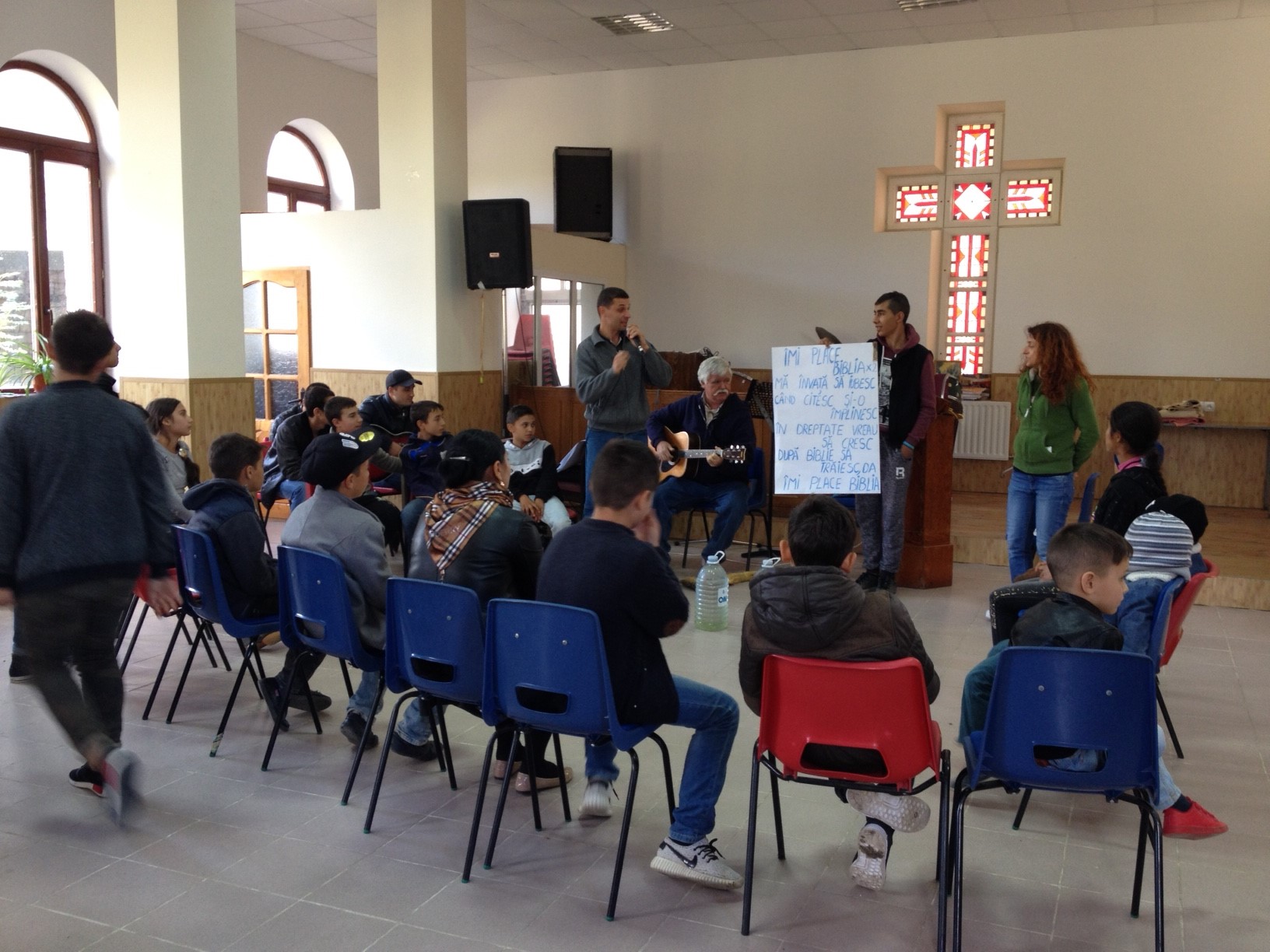
prepared one day of camp . . .

which they led
for children in a different village
by singing . . .

. . . acting out the story of
the Lost (and found!) Coin . . .

. . . and sharing the Gospel
through a craft with colored beads.
I don't have a photo yet of this year's camp--being held today, tomorrow, and Saturday (July 6, 7, 8).
The people in the Moldovan church are doing it all themselves.
Well, with God's help and our prayer support.
Staying home but still praying,
| . |
Mary VanRheenen

 Fortunately, many regular grocery stores stock gluten-free products. Michael carried a supply with him to places like this Sunday afternoon feast with our Roma brothers and sisters from Moldova who are working in North Holland. They were eager to celebrate the Lord's Supper with us and with their pastor Petru Ciochina, who had traveled from Moldova for this weekend.

Romany believers from Bethlehem Baptist Church in Moldova have been going abroad to work for many years.
 |
Isn’t it possible, someone asked pastor Petru Ciochina earlier this month, for believers to earn a living in Moldova and build up their church there? No, Petru replied. He gave the example of two women who wanted to work in a sewing factory. Oh, they were told, this work is too hard for you; you wouldn’t like the hours; the pay wouldn’t be enough for you . . ..”
Really, they didn’t get the job because they were Roma. (Note that it was different in the Soviet days when these two Roma women did work in a sewing factory--a factory which subsequently closed.)
Even if Roma can find work, salaries in Moldova are low but living expenses (due to inflation) are high. And Roma tend to have more than just two children. children. It would be difficult to earn enough in Moldova to support their families.
So the Roma go abroad. They come back for holidays, family celebrations, and to attend to business at home. Some go to Poland to beg (by Catholic religious sites). Christians do not do this. They go to Germany or the Netherlands to work. For example, those in North Holland have jobs in greenhouses picking tomatoes and cucumbers.

Pray with us for all who go abroad to work.
And welcome those who must go abroad to work, for whatever reason.
Prayerfully, Mary & Keith
NOTE: North Holland is a province in the Netherlands. Amsterdam is in the province of North Holland. Rotterdam and De Hague are in the province of South Holland. We live near Arnhem in the province of Gelderland.

