Friday, September 8, 2023

Turkish Romany--Prayer Request


There are an estimated 5,000,000 Romany in Turkey. Years ago, when CBF had field personnel in Turkey,
there was a job request for someone to work with those people. That request was never filled. At least, not by us.

Yesterday, we received a prayer request from Romany Christians in a neighboring country. They and a team of 24 young people will be working with Turkish Romani for the next five days. 


Pray with us for wisdom and protection. Pray also that the Gospel will cross borders to reach Romany in Turkey as well as Turkish Romany living elsewhere!


(Photo:  Roma family near Smyrna, Turkey, ca 1903. Wikipedia.)

Thursday, August 31, 2023


ACTIVISTS TAKE LEGAL ACTION AFTER ROMANI WOMAN GIVES BIRTH ON PAVEMENT OUTSIDE HOSPITAL IN ROMANIA

24 August 2023: The European Roma Rights Centre (ERRC) and the Romani Lawyers Association ROMAJUST have taken legal action against a Romanian hospital  on behalf of a 24-year-old Romani woman who gave birth outside on the pavement after being refused medical care. 

The woman, who is deaf and from a Romani community, was denied due to the hospital lacking a gynaecology ward. The Romani woman is from BarbuleČ™ti, a community where according to the last census almost 80% of the population were Roma. 

According to the hospital, when the Romani woman arrived at the hospital the manager called an ambulance to take her 60 kilometres away to Slobozia. The reasoning the manager gave to local news was: “we don't have a gynaecology ward." Referring to the lack of specialized doctors, the emergency unit staff were contacted to send an ambulance. However, the patient was not consulted, supervised, or escorted to the ambulance car. Instead, she was told to wait for the ambulance outside the hospital. The woman was not sufficiently cared for by medical staff and was left waiting outside a hospital, where she eventually gave birth on the pavement, sparking local outrage and demands for action.

This incident has been deemed "unacceptable" by the Romanian Ministry of Health, who has demanded the dismissal or resignation of the hospital manager. An investigation has been launched to sanction possible incidents of discrimination under the law so that all citizens, regardless of their ethnicity, have equal access to public services and facilities. The incident has prompted calls for better healthcare access, personnel, and facilities for marginalised communities in Romania. 

For more information or to arrange an interview, contact:

Jonathan Lee (in English)
Advocacy & Communications Director
European Roma Rights Centre
jonathan.lee@errc.org
+32 49 288 7679


The European Roma Rights Centre (ERRC) is a Roma-led international public interest law organisation working to combat anti-Romani racism and human rights abuse of Roma through strategic litigation, research and policy development, advocacy and human rights education. For more information about the European Roma Rights Centre, visit our website at: http://www.errc.org


Saturday, August 26, 2023


TRAINING OPPORTUNITY FOR ORGANISATIONS SUPPORTING ROMA AND TRAVELLERS: COUNCIL OF EUROPE MECHANISMS TO MONITOR JUDGMENT IMPLEMENTATION AND ADVANCE ROMA AND TRAVELLER RIGHTS

We are excited to announce an open call for participation in an initiative aimed at strengthening the capacities of civil society organisations supporting Roma and Travellers to engage with Council of Europe mechanisms. We want to create a comprehensive support system that will enable organisations to enhance their knowledge and understanding of the standards set by the Council of Europe and the monitoring mechanisms in place for advancing and promoting the rights of Roma and Travellers, as well as their inclusion in society. The focus is on legal advocacy and providing evidence to ensure the execution of European Court of Human Rights (ECtHR) judgments for Roma and Travellers.

Project Overview:

The project is designed to provide Roma and Traveller supporting civil society organisations with the expertise and skills necessary to engage more effectively with the standards and mechanisms established by the Council of Europe. 

Our project will train organisations in submitting evidence to Council of Europe bodies, taking part in a monitoring scheme focussing on implementation of ECtHR judgments, and utilising mechanisms such as ‘Rule 9’ applications in cases of non-implementation of judgments.  Our goal is to empower Romani and Traveller communities through civil society organisations, helping them navigate to the complex landscape of rights and legal protections. 

Why Participate?

Through this initiative, your organisation will be able to play a pivotal role in shaping and advancing the rights of Roma and Travellers. Working with other dedicated organisations, you will become part of a monitoring network committed to driving positive legal change at both the national and European levels. This collaboration will not only provide a platform for strategic partnerships but also open doors to joint projects, advocacy campaigns, and coordinated actions aimed at making a lasting impact.

Our training will provide participant organisations with:

  • Knowledge & expertise on the Council of Europe standards and monitoring mechanisms relevant to Romani and Traveller inclusion.
  • Technical assistance to effectively utilise Council of Europe standards and mechanisms, with an emphasis on the implementation of judgments.
    • Including ‘Rule 9’ submissions to the Committee of Ministers to provide evidence aiding in the supervision of the execution of judgments.
  • An opportunity to collaborate and contribute to the capacity-building of other Roma and Traveller civil society organisations concerning Council of Europe standards and monitoring mechanisms.

More specifically, the project will include:

  • Two collective online sessions for all partner organizations on 18th and 22nd September 2023, aimed at deepening the understanding of Council of Europe standards and mechanisms.
  • Customized coaching sessions for each organization, involving a minimum of two online interactions throughout October 2023. These tailored sessions will encompass diverse aspects, including communication capabilities, organizational strategies, and the socio-political context in which these organizations operate.
  • Individual meetings will address key objectives, such as knowledge enhancement, skill development, attitude shaping, and strengthening capabilities in areas like monitoring, research, data collection, and advocacy document drafting, all aligned with Council of Europe standards.
  • Collaborative preparation and discussion of briefings by Roma and Traveller CSOs during the 16th Meeting of the Council of Europe Dialogue in Strasbourg, 14-15 November 2023. These briefings will address pressing human rights challenges faced by Roma communities, covering a wide array of pertinent issues.

As a valued participant in this initiative, each organization selected will receive an honorary participation fee to recognise their contribution to the project's success. Additionally, all travel expenses for the trip to Strasbourg will be covered. We are committed to facilitating your involvement and ensuring that your dedication to advancing Roma and Traveller rights is both acknowledged and supported.

All training will be facilitated by the ERRC. 

Who can apply?

Organisations focussed on protecting the rights of Romani and Traveller communities. We will prioritise organisations with experience in strategic litigation, monitoring and reporting on human rights situations, and a demonstrated motivation to engage in capacity-building and communication efforts.

Application Process:

If your organisation is interested in taking part, please send an email to george.ballas@errc.org by 23:59 on 10th September 2023 with the following information:

  • Brief description of your organisation: its goals, activities, scope, and country or region.
  • A statement (of no more than 500 words) explaining your interest in joining the initiative.

All applicants will receive a response, irrespective of the outcome. Final decisions will be made by the project's management and communicated to applicants.

For inquiries or additional information, please contact George Ballas at george.ballas@errc.org.

This project is funded by the Council of Europe.

25 August 2023
© ERRC 2023. All rights reserved.


The European Roma Rights Centre (ERRC) is a Roma-led international public interest law organisation working to combat anti-Romani racism and human rights abuse of Roma through strategic litigation, research and policy development, advocacy and human rights education. For more information about the European Roma Rights Centre, visit our website at: http://www.errc.org

To support the ERRC, please visit this link: http://www.errc.org/en-donate.php

European Roma Rights Centre
Avenue de Cortenbergh 71, 4th floor
1000 Brussels, Belgium


Friday, August 18, 2023


The Danube actually is blue, as Keith discovered when he recently visited Romania. 


He was recording the Jesus Film in the Lipovan

 language. Many members of this ethnic group live in the Danube Delta.


Here's some more photos of his time there.


I look forward to visiting there sometime myself. Care to join us?


Monday, July 31, 2023

Look! There’s an alligator.


Have you ever seen something that, just for a split second, your mind thought was something else. And then you laughed at yourself because the thing you thought you saw would be impossible. (No, that wasn’t Richard Nixon I saw at the mall.) 


That happened to me a few weeks ago. I thought I saw an alligator in Romania. To be fair, I was on a boat trip in the Danube delta, and everything around me looked like Louisiana.  A river that branches into smaller and smaller waterways, that then open into enormous shallow lakes separated by reed marshes. We saw hundreds of waterfowl: ducks and egrets, both big and small. The rest of the people in the boat were very excited to see pelicans for the first time in the wild. They passed me the binoculars. I didn’t want to spoil their excitement by telling them that I have seen plenty of pelicans and that pelicans are on our state flag.  


So when we returned to a small waterway with trees growing in and out of the water and passed pairs of men fishing from flat-bottom boats, and I saw small log floating near the bank, I almost yelled, “There’s an alligator!” Fortunately, my brain quickly remembered that there are no alligators in Europe.  


There are, however, Cajuns. Well, sort of. The Lipovan (Lee-po-VAHN) people who live in the Danube delta, often in villages only accessible by boat, and who mostly work in the fishing industry, speak a 300-year-old dialect of a language that is not the language of the country they live in.


Their language, a dialect of old-Russian, is looked down on by both Romanians and by those who speak “proper” Russian. The city folk in Tulcea (population 75,000), consider the 25,000 Lipovans to be smelly fisherfolk who drink too much. Like Cajuns in the 1950s, young people in school may even deny that they speak or even understand their own language. But they do have a rich culture, based on food, family, music, and religion. 


I was in Tulcea recording the Lipovanski version of the Jesus film. One afternoon we were recording the narrator, Alex, a young man who also owns the studio. During a break, he grabbed an accordion and sang for us a Lipovan folk song. I was impressed with both his playing and his singing. Alex said that he also sings in church. I told him that I thought it would be very interesting to visit a Lipovan church. Alex explained that the Lipovan Orthodox Old-Rite Church is a branch of the Old Believers, who split off from the Orthodox Church in the 17th century.


In the church they don’t speak Lipovanski, or even Russian. Instead, the service is in Old Church Slavonic. Again, this is similar to Cajuns in the 1950s, whose church services were not even in French, but were in Latin, a language nobody listening really understood. Alex thought it was wonderful that with the Jesus film, the Lipovans would actually get to know the Bible stories instead of just hearing him sing the liturgy in a language they don’t understand.  


The last afternoon that we were in Tulcea, after we had finished all the recording and I had put it together with the video, we sat down and reviewed the whole thing to make sure there was nothing missing and there were no mistakes.


Brother Nicu, the representative from Campus Crusades partner organization in Romania, sat next to two Lipovan men who had had major speaking parts. Afterwards, Nicu told me that he looked over and saw that both men had tears in their eyes from hearing the word of God in their own language.  


Alligators in the Danube may not be possible, but grown men being touched by Jesus’ life and resurrection is. Thank God.  


Keith Holmes

Thursday, July 6, 2023

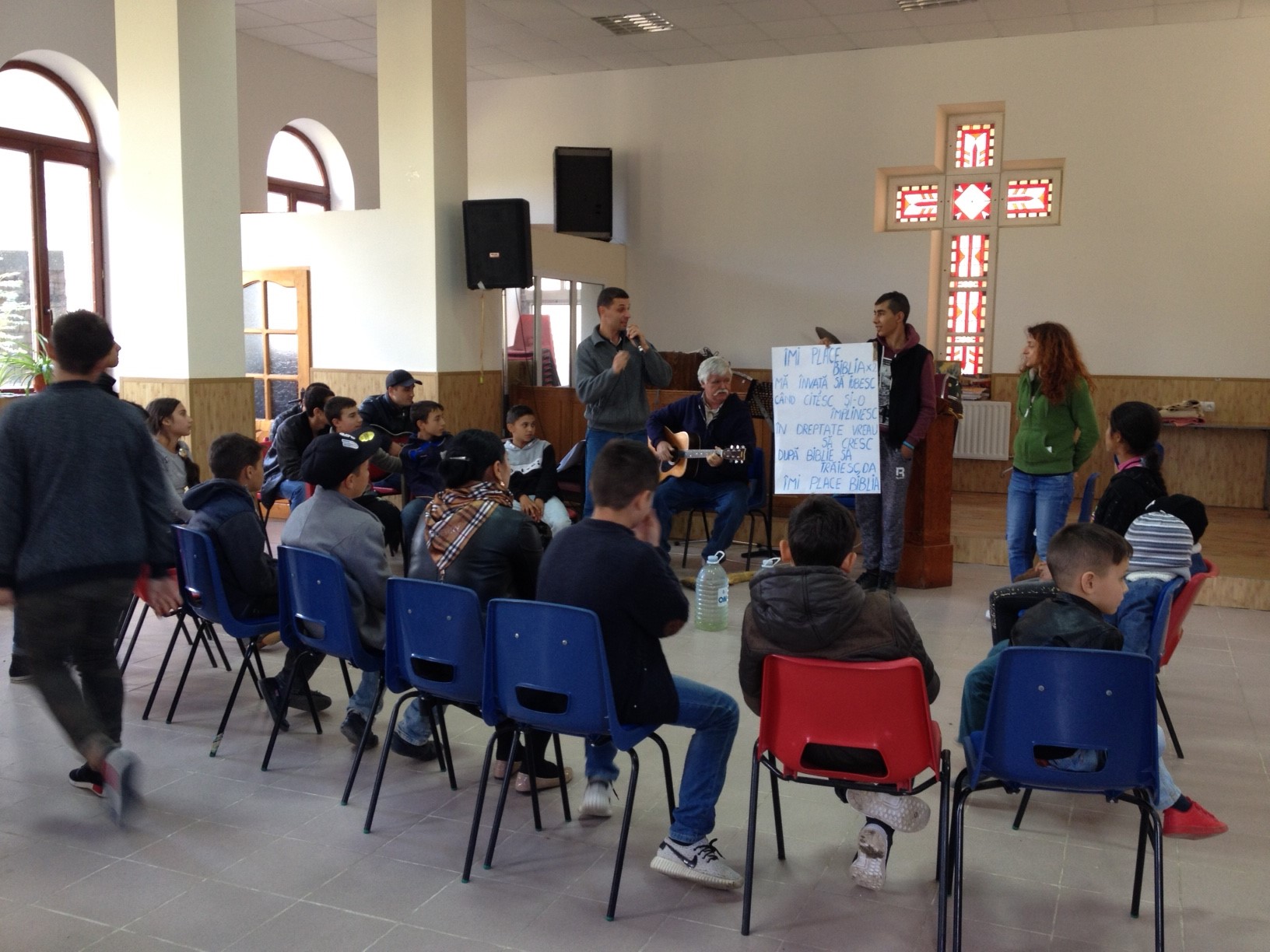
Here's some photos 

from the first time I went to Moldova 

to help with a children's day camp (VBS) 

in the village of Vulcanesti.

Over 20 years ago, it was just me, 

three Americans + one Moldovan translator. 

We did everything ourselves.


Here's some photos from one of the last times I helped with a children's program in Moldova. 


This time, the children and youth 

in Vulcanesti 

prepared one day of camp . . . 


which they led 

for children in a different village

by singing . . .


. . . acting out the story of 


the Lost (and found!) Coin . . .


. . .  and sharing the Gospel 

through a craft with colored beads.


I don't have a photo yet of this year's camp--being held today, tomorrow, and Saturday (July 6, 7, 8). 

The people in the Moldovan church are doing it all themselves. 

Well, with God's help and our prayer support.


Staying home but still praying,

.

Mary VanRheenen


Monday, June 12, 2023

Breaking (Gluten-free) Bread


When representatives rom our Encourager Church in Columbia, MO, visited, breaking bread together took on new meaning. Michael McEntyre(pictured on the right, far away from the stack of bread) cannot eat gluten. Gluten is normally found in all kinds of bread made from wheat flour. 


Fortunately, many regular grocery stores stock gluten-free products. Michael carried a supply with him to places like this Sunday afternoon feast with our Roma brothers and sisters from Moldova who are working in North Holland. They were eager to celebrate the Lord's Supper with us and with their pastor Petru Ciochina, who had traveled from Moldova for this weekend. 
When Petru invited Michael to share in leading this part of our worship time, Michael pulled out one of his gluten-free breads. "Genial! (great)" Petru exclaimed. 
He put the mini-loaf on the plate, and we all at the same bread, gluten-free.

Thank you, Jesus!